FREE SHIPPING ON ALL ORDERS OVER $50
The Pagan Roots of the Bible
Christmas, Nimrod, Roman Power, and the Politics of Spiritual Compromise
12/24/20253 min read
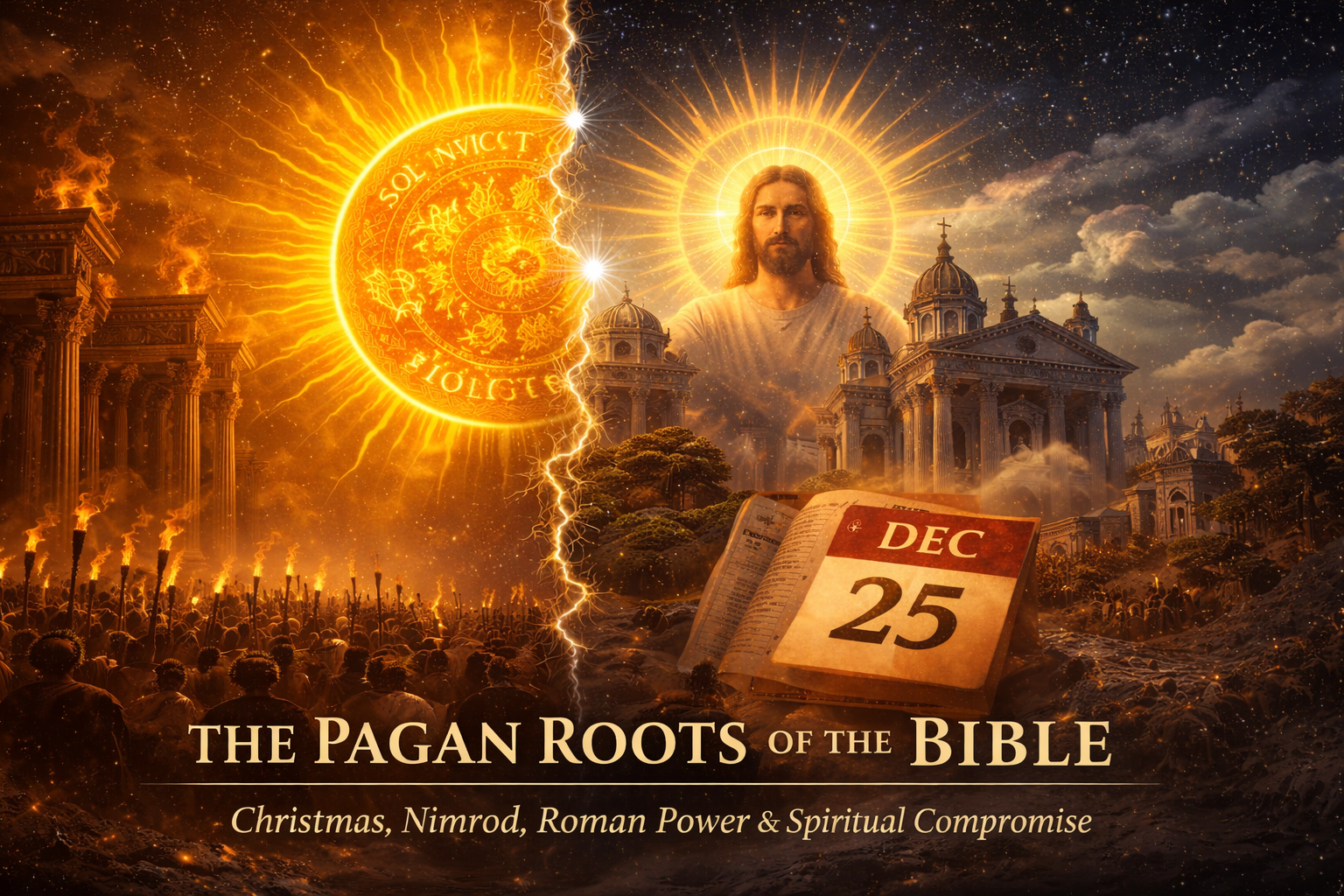
For many seekers on a path of awakening, the most transformative moments do not come from learning something new, but from unlearning what was never questioned.
One of the most emotionally charged examples of this is Christmas.
Celebrated globally as the birth of Jesus Christ, Christmas is often assumed to be a purely Christian tradition. Yet when we step back from modern sentiment and examine history, scripture, and ancient religious practices, a far more complex story emerges. One that reveals layers of pagan symbolism, imperial politics, and strategic compromise woven into what later became Christian doctrine.
This is not an attack on faith.
It is an invitation to understanding.
Before Christmas, There Was the Sun
Long before Christianity emerged, civilizations across the ancient world honored the Winter Solstice, the moment when the sun reaches its lowest point in the sky before being “reborn” as days begin to lengthen again.
This solar rebirth was celebrated under many names:
• Saturnalia in Rome
• Sol Invictus, the “Unconquered Sun”
• Yule among Germanic tribes
• Mithra’s birth in Persian traditions
• Tammuz in Babylon
• Horus in Egypt
These celebrations occurred around December 21–25, not by coincidence, but by astronomy.
The sun “dies,” pauses for three days, and is reborn.
This cycle predated Christianity by thousands of years.
Notably, the Bible never gives a date for Jesus’ birth. Early Christian scholars widely acknowledged this. In fact, many believed Jesus was more likely born in spring.
So why December 25?
Nimrod, Babylon, and the Mother-Child Archetype
To understand the deeper symbolic roots, we must go back to Babylon.
According to ancient texts and later theological analysis, Nimrod was a powerful ruler described in Genesis as a “mighty hunter before the Lord.” Extra-biblical traditions portray him as a god-king figure associated with empire-building, sun worship, and rebellion against divine order.
After Nimrod’s death, legend holds that his consort Semiramis proclaimed a miraculous virgin birth of a son, Tammuz, who was said to be Nimrod reincarnated. This created one of the earliest known mother-child deity systems, later echoed across cultures.
This archetype reappears repeatedly:
• Isis and Horus
• Devaki and Krishna
• Semiramis and Tammuz
• Later, Mary and Jesus
The form changes.
The symbolism remains.
This does not negate Jesus’ teachings.
It reveals how older religious frameworks were repurposed to make new beliefs familiar.
The Christmas Tree and Biblical Warnings
One of the most controversial aspects of Christmas is the tree.
Jeremiah 10:2–4 states:
“Do not learn the ways of the nations… for the customs of the peoples are vain. A tree is cut from the forest, worked with an axe, decorated with silver and gold, and fastened so it will not topple.”
While often debated, the imagery is strikingly similar to modern Christmas trees.
In ancient pagan cultures, evergreen trees symbolized eternal life, fertility, and the life force of nature. Decorating them was an act of reverence. In scripture, however, such practices are repeatedly warned against when they become objects of devotion.
The concern was never greenery itself.
It was idolatry.
External symbols replacing inner alignment.
Rome’s Crisis and the Politics of Conversion
By the 3rd and 4th centuries, Christianity was no longer a small persecuted sect. It was growing rapidly, especially among the poor and enslaved. At the same time, Rome was fracturing.
Civil unrest, religious tension, and cultural division threatened imperial stability.
When Emperor Constantine legalized Christianity in 313 CE, Rome faced a dilemma:
How do you convert millions of pagan citizens without tearing the empire apart?
The answer was compromise.
Rather than eliminate pagan traditions, Rome absorbed them.
• Pagan festivals were rebranded as Christian holidays
• Solar deities were replaced with Christ imagery
• Existing temples were repurposed as churches
• Familiar symbols were given new names
December 25 became Christ’s birthday.
Sol Invictus became the “Light of the World.”
The sun halo became the saint’s aura.
This was not accidental theology.
It was political strategy.
Faith, Power, and Consciousness
Understanding this history does not require abandoning spirituality.
It requires maturity.
Jesus’ core teachings were not about holidays, trees, or rituals. They were about inner transformation, compassion, liberation from fear, and communion with divine consciousness.
But institutions are built by humans.
And humans negotiate power.
When faith becomes state-sanctioned, it adapts.
When belief meets empire, symbolism is reshaped.
Recognizing this allows us to reclaim spiritual autonomy.
Awakening Beyond Inherited Tradition
At Gaia’s Awakening, we believe true spirituality begins where blind inheritance ends.
You are not required to reject Christmas.
You are invited to see it clearly.
You are not asked to abandon Christ.
You are encouraged to separate his teachings from imperial overlays.
Awakening is not about replacing one belief with another.
It is about remembering what was always within you.
Truth does not fear history.
Light does not require decoration.
And divinity was never confined to a date on a calendar.
✨ Reflection for the Seeker
What traditions do you participate in out of habit rather than resonance?
What symbols still serve you, and which ask to be released?
Awareness itself is the ritual.